248.723.6275
 Bloomfield Hills, MI


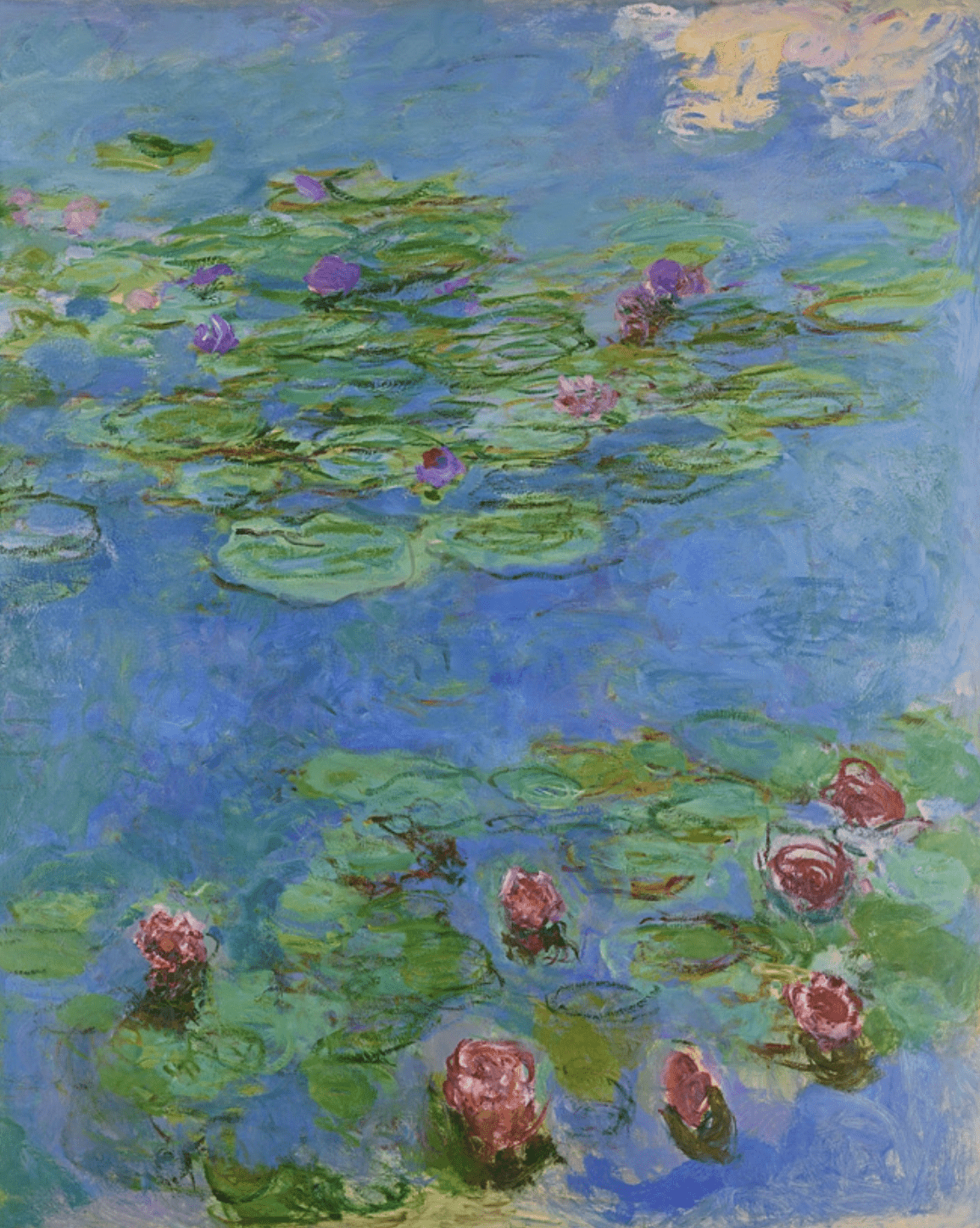
Water Lilies (Nymphéas), Claude Monet
c. 1907–1914
Oil on canvas
In his later years, Claude Monet shifted his focus almost entirely to the water garden he meticulously cultivated at his home in Giverny, France. Using this unusual vertical format, he eliminates the horizon line and the banks of the pond entirely. This composition forces the viewer’s gaze downward onto the water’s surface, collapsing the physical distinction between the water lilies floating on the pond and the reflections of the sky and unseen trees above. The vibrant interplay of deep blues, lush greens, and vivid pinks captures the fleeting, ever-changing nature of light and atmosphere, pushing the boundaries of traditional landscape toward modern abstraction.
Insights
- One of a Large Series
Water Lillies is one of approximately 250 distinct oil paintings in the Water Lilies (Nymphéas) series. Monet spent the last 30 years of his life obsessively painting this single aquatic environment.
- Painting Through Blindness
Monet developed severe cataracts later in his life, which drastically altered his color perception. As his vision deteriorated, his paintings began to take on heavier, muddier blue, purple, and red tones because he was physically losing the ability to see the full color spectrum.
- Controversial Botanicals
Monet didn’t just paint the lilies; he architected the entire pond. He imported exotic water lily cultivars from Egypt and South America. Local authorities and farmers demanded he uproot them, fearing the foreign plants would poison the local water supply. Monet ignored the demands.
- The Original "Immersive" Art
Monet’s grandest vision for his water lilies was a massive, panoramic installation. He donated a series of immense mural-sized panels to the French government, which are now housed in two custom-built, oval rooms at the Musée de l’Orangerie in Paris—a space often described as the “Sistine Chapel of Impressionism.”
- The "Blot" Technique
If you look closely at the pink and red blooms in the lower half of the painting, you can see Monet’s use of thick, quick dabs of unblended color applied with a flat brush. This technique is known as taches (French for “blots”), which became a defining hallmark of Impressionism.
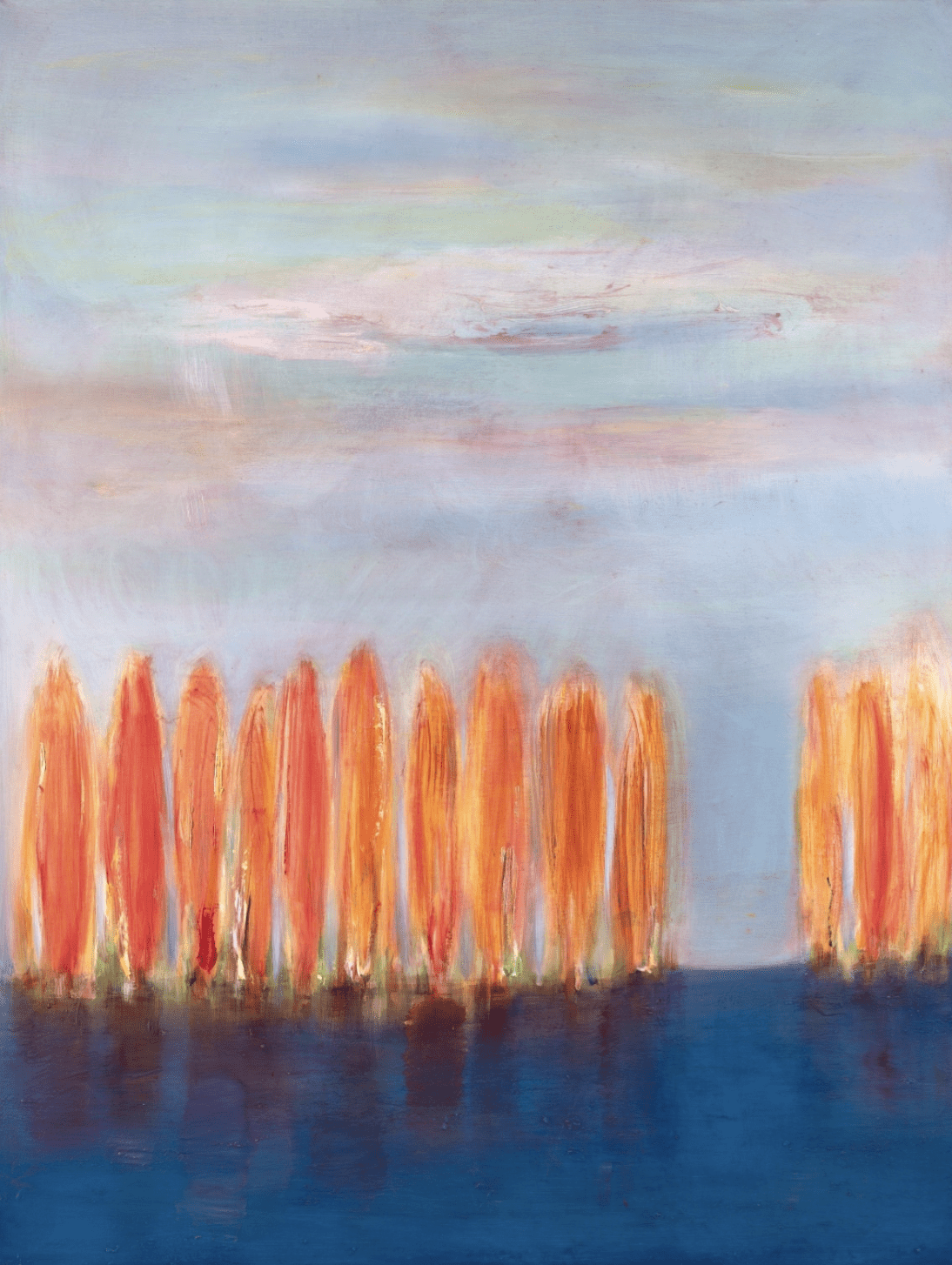
Poplars, Micky Allan (Lake Burley Griffin from Kingston foreshore),
Australian, b. 1944
2004 Oil on linen Canberra Museum
In this vibrant, dreamlike landscape, Micky Allan captures the autumnal transformation of the poplar trees lining the Kingston foreshore (the part of the seashore between high-water and low-water marks. Departing from strict realism, she uses luminous, high-key colors and abstracted, flame-like vertical strokes to convey the emotional and spiritual resonance of the changing seasons. The reflection of the trees in the deep blue waters of Lake Burley Griffin grounds the composition, illustrating the artist’s deep thematic interest in natural cycles and inner landscapes.
Insights
- From the Avant-Garde to the Easel
Allan initially rose to prominence in the 1970s as a pioneering photographer tied to Melbourne’s radical, experimental Pram Factory collective. She was highly regarded for her unique technique of delicately hand-tinting black-and-white photographs. Her later pivot to vivid, large-scale oil paintings like Poplars marked a significant evolution from documentary-style work to exploring highly subjective, metaphorical territories.
- A Designed Landscape
The subject of the painting, Lake Burley Griffin, is an artificial body of water located in the exact geographic center of Canberra. Completed in 1964, the lake and its surrounding foreshores—including the intentionally planted poplars—were part of the original blueprint for the Australian capital, designed by American architects Walter Burley Griffin and Marion Mahony Griffin.
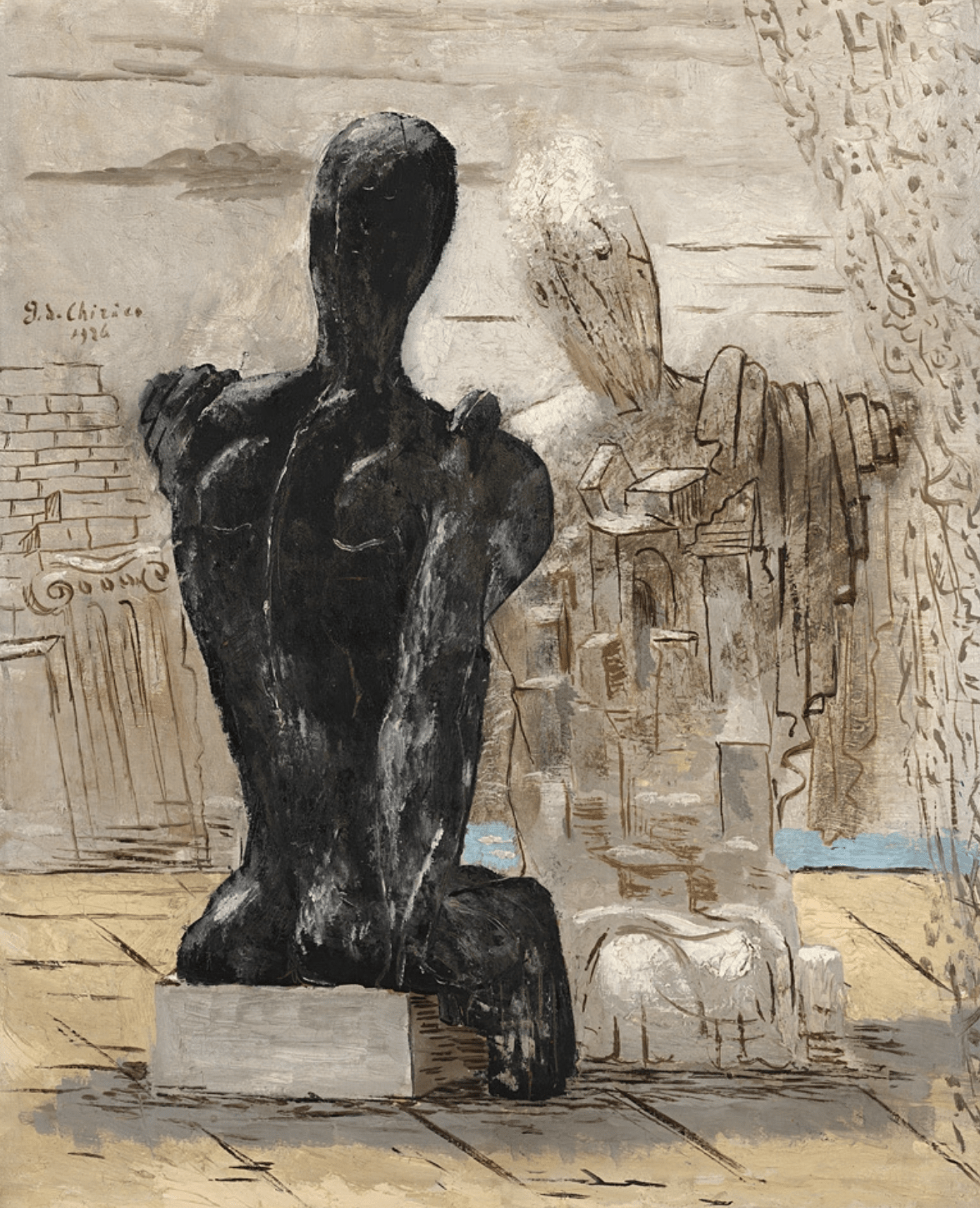
The Mysterious Archaeologists, Giorgio de Chirico
Italian, 1888–1978
1926 Oil on canvas
In The Mysterious Archaeologists, each figure is represented in a unique tonality which makes them seem to be made of stone, as if they themselves were ancient sculpture. The picture’s whole surface, which is almost uniformly monochrome, is interrupted only by the thick azure stripes behind the light mannequin and by the dark marks of the other figure’s back. The true originality of this work comes from the neat contrapposto of the two figures, one seen from the front, the other from the back, one light, the other dark, a juxtaposition that intrigues with its profound meaning and which has led the work to be given the second title of Day and Night.
Insights
- Metaphysical Founder
Giorgio de Chirico founded the Metaphysical Art movement, which heavily influenced Surrealism.
- Faceless Figures
De Chirico often used mannequin-like characters instead of realistic human faces to create emotional distance and mystery.
- Ancient Inspirations
The artist drew inspiration from Greek mythology, classical ruins, and Renaissance architecture.
- Dreamlike Spaces
His paintings are known for distorted perspectives, long shadows, and eerie empty settings that feel like dreams.
- Surrealist Influence
Artists such as Salvador Dalí admired de Chirico’s strange imagery and psychological atmosphere.
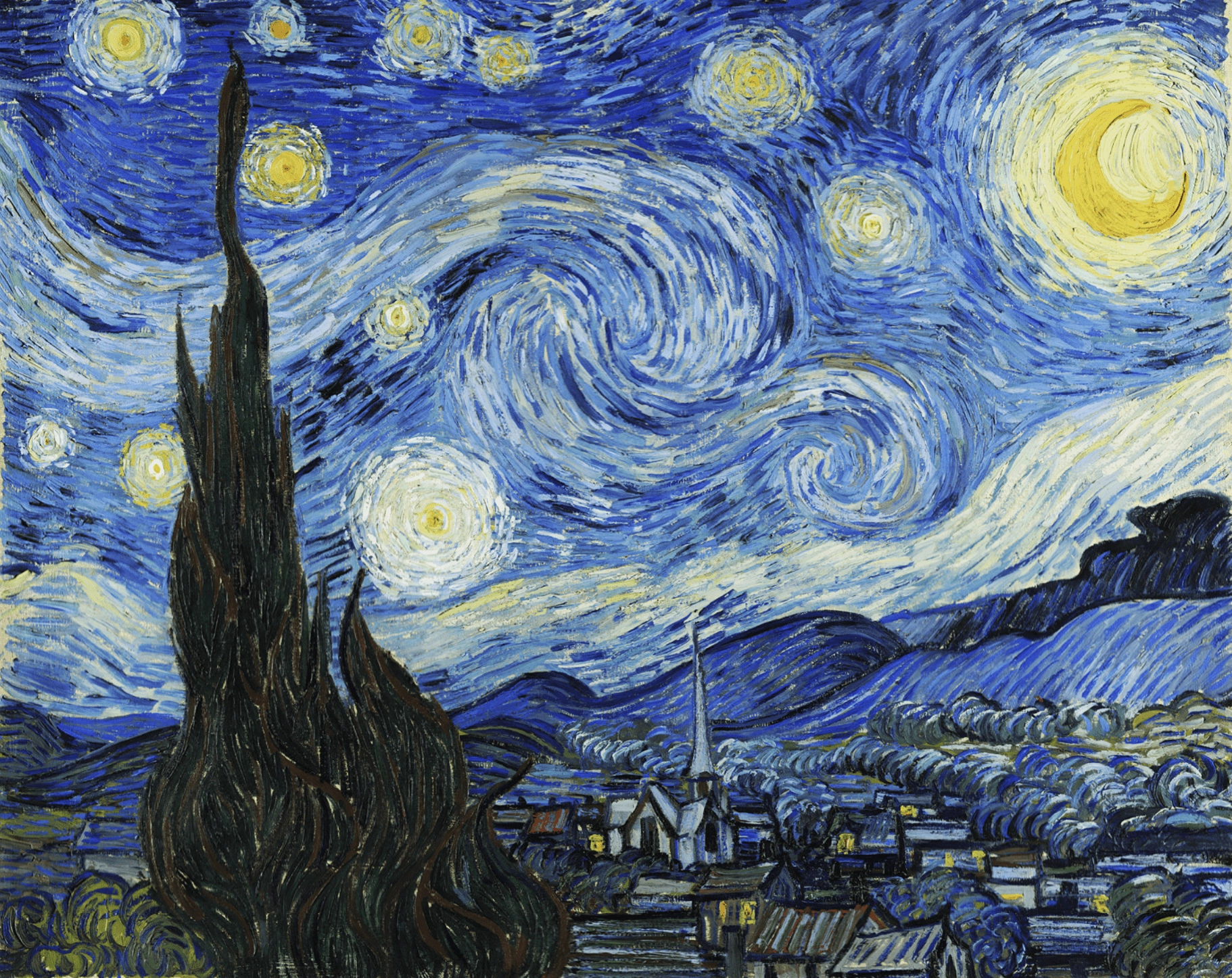
The Starry Night, Vincent van Gogh
Dutch, 1853–1890
1889 Oil on canvas
Painted during his stay at the Saint-Paul-de-Mausole asylum in Saint-Rémy-de-Provence, The Starry Night is a masterpiece of post-impressionist expression. Rather than depicting the night sky as a static, dark void, van Gogh animates the heavens with swirling, turbulent currents of blue and yellow. The exaggerated, radiant halos around the stars and the crescent moon create a cosmic energy that dwarfs the quiet, sleeping village below. His thick, impasto brushstrokes—applied with intense emotion—transform a simple landscape into a profound meditation on nature, infinity, and human vulnerability.
Insights
- Painted from Memory
Unlike many of his landscapes, which were painted outdoors (en plein air), van Gogh painted The Starry Night entirely from memory and imagination inside his asylum studio during the day.
- Astronomical Accuracy
Despite its swirling, dreamlike appearance, astronomers have noted that van Gogh accurately mapped the position of the moon and the planet Venus (the brightest “star” in the painting) as they would have appeared in the French sky in June 1889.
- A Reused Canvas
Because canvas was expensive and he was entirely financially dependent on his brother Theo, van Gogh frequently scraped down and painted over older works. The Starry Night was painted on a fresh canvas, but it represents the culmination of a “night sky” theme he had been obsessing over for years.
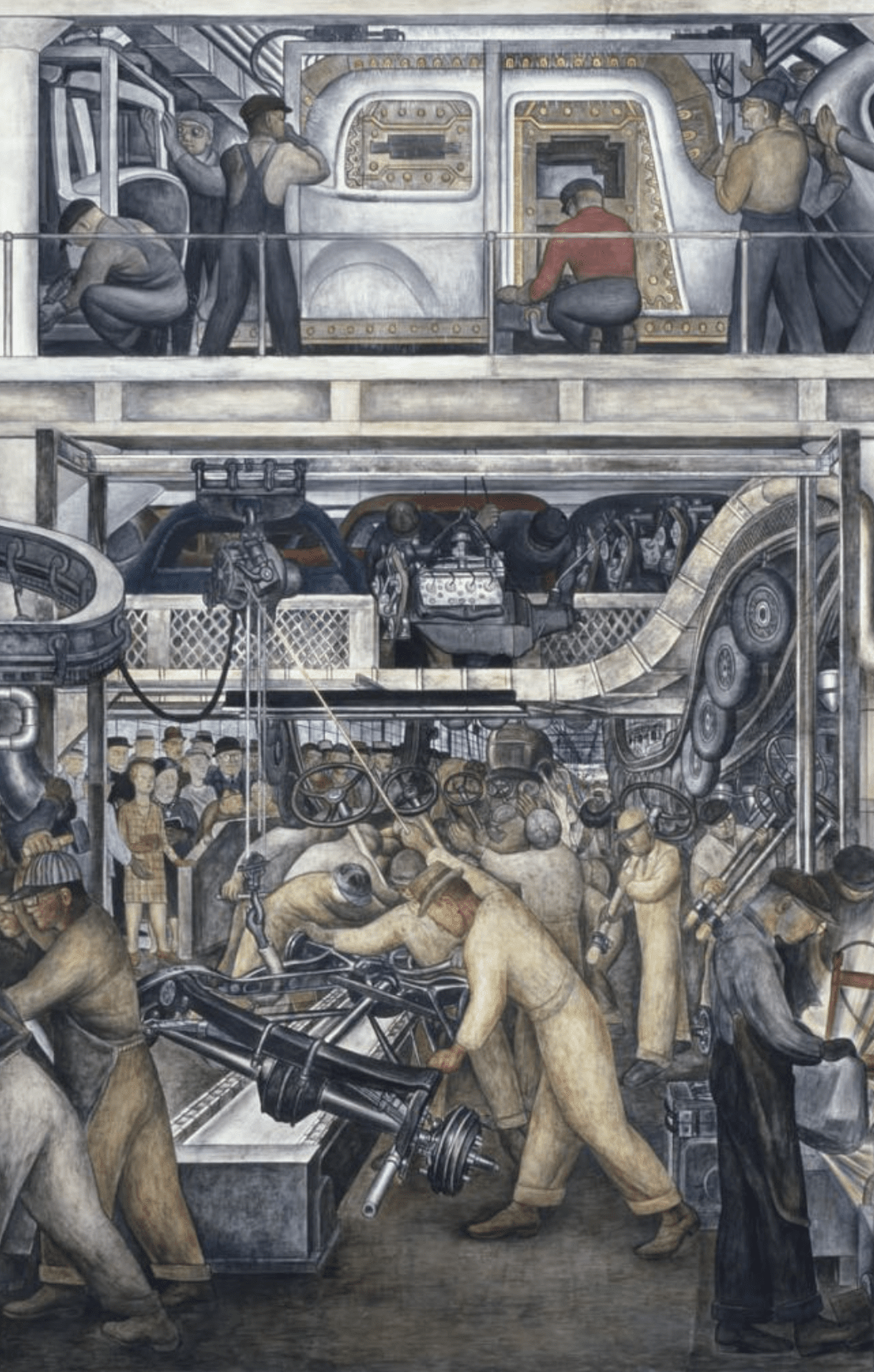
Detroit Industry Murals, Diego Rivera
Mexican, 1886–1957
1932–1933 Fresco (painting onto wet plaster)
Commissioned by the Detroit Institute of Arts and funded by Edsel Ford, Diego Rivera’s sprawling mural cycle is a monumental tribute to the city’s manufacturing workforce. This detailed section captures the chaotic yet highly choreographed rhythm of the Ford Motor Company’s River Rouge Plant. Rivera depicts the laborers, the twisting conveyor belts, and the massive machinery in a muscular, heroic style that emphasizes the power and dignity of the working class. The dense, layered composition mirrors the relentless, overwhelming energy of the assembly line itself.
Insights
- A Controversial Masterpiece
When Rivera’s murals were unveiled, they were controversial. Critics deemed them Marxist propaganda, while others were upset that he painted the factory workers as a multi-racial, unified workforce—a radical concept at the time.
- Ancient Techniques
Rivera used the traditional buon fresco technique, painting directly onto wet plaster. This meant he had to work quickly and flawlessly before the plaster dried, a method dating back to the Renaissance and ancient Rome.
- Ford's Defense
Despite calls from religious and political leaders to white-wash the murals, Edsel Ford (the president of the Ford Motor Company) defended the artwork, and the museum refused to destroy it.
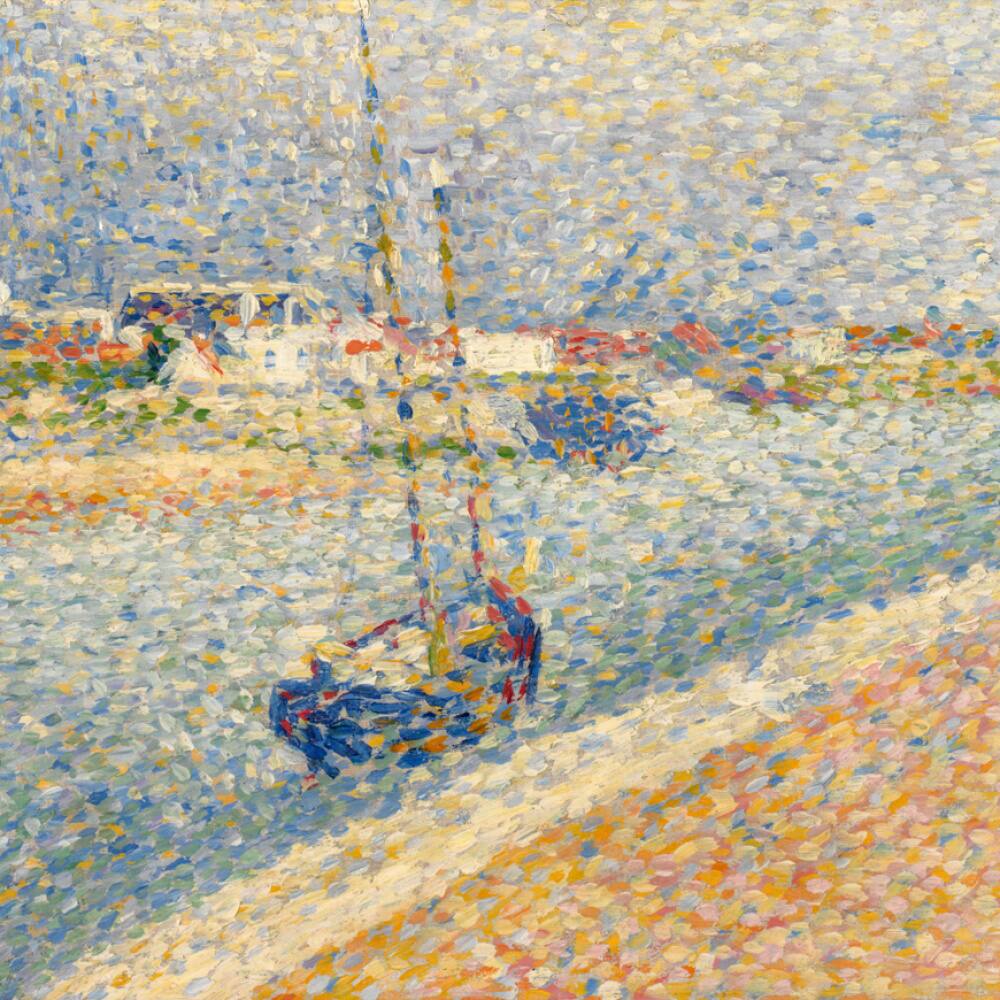
The Channel of Gravelines, Petit Fort Philippe, Georges Seurat
French, 1859–1891
1890 Oil on canvas
In this tranquil maritime scene, Georges Seurat employs his revolutionary technique of Pointillism—or Divisionism, as he preferred to call it. Instead of mixing colors on a palette, Seurat applied thousands of tiny, distinct dots of pure color directly onto the canvas. He relied on the viewer’s eye to optically blend these dots from a distance, creating a shimmering, luminous effect. The small sailboat with its blue hull is built not from solid brushstrokes, but from a precise, scientific arrangement of complementary blues, oranges, and whites, capturing the brilliant coastal light of northern France.
Insights
- A Scientific Approach
Seurat based his pointillist technique on the contemporary color theories of scientists like Michel Eugène Chevreul, who studied how colors placed side-by-side alter our perception of one another.
- A Short-Lived Genius
Seurat died suddenly of an illness at the young age of 31. Despite his short career, he completely altered the trajectory of modern art, shifting Impressionism from an intuitive practice to a highly calculated science.
- Painted Frames
If you look closely at the edges of many Seurat paintings, you will notice he often painted a border of contrasting dots directly onto the canvas edge or the physical wooden frame to make the interior colors “pop” even more.
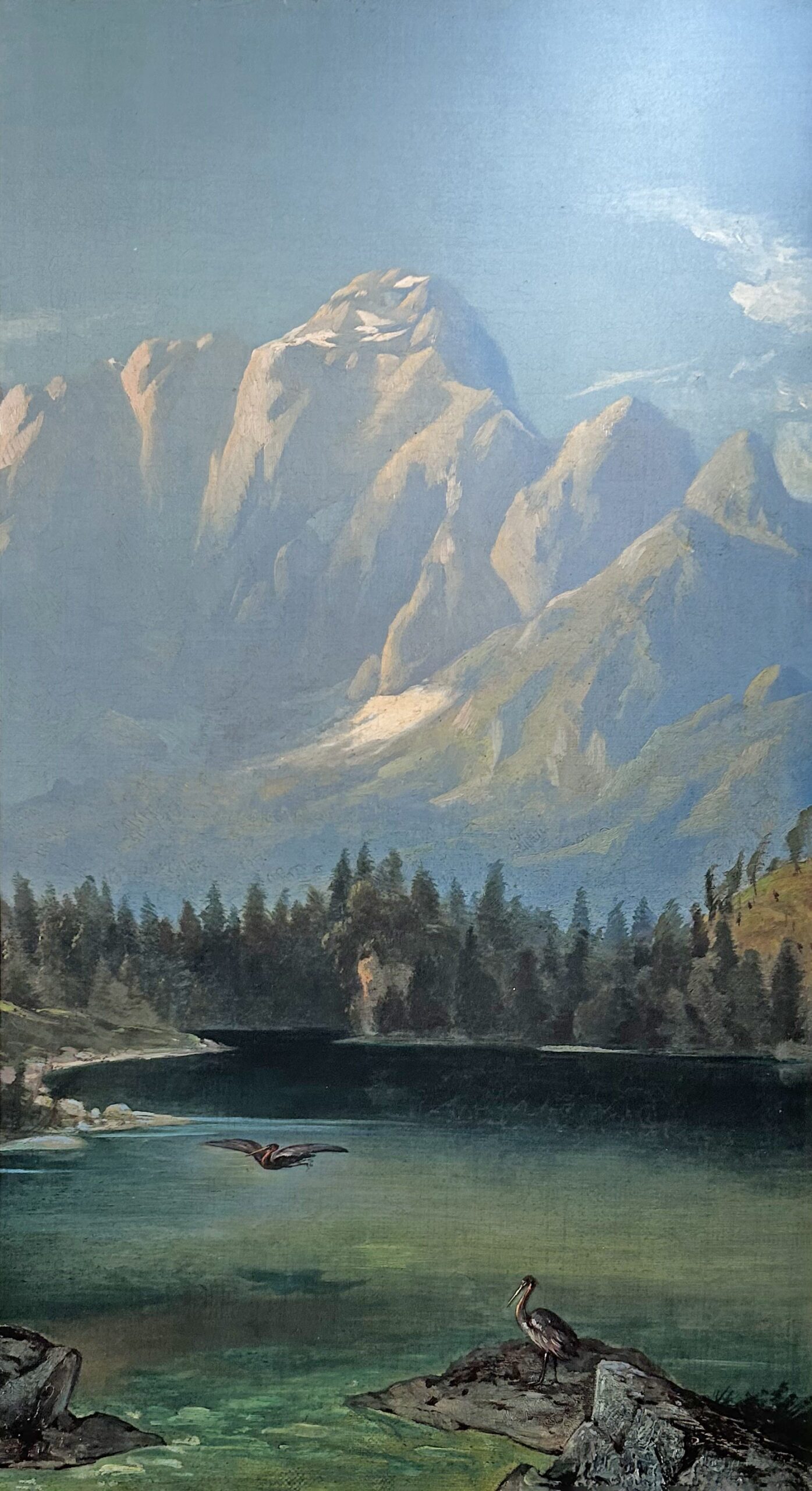
Mountain Landscape with Lake, Albert Bierstadt
American, born Germany, 1830–1902
c. 1870–1875 Oil on canvas
As a leading figure of the Hudson River School, Albert Bierstadt is celebrated for his sweeping, romanticized visions of the American West. This painting exemplifies his theatrical approach to landscape, utilizing a dramatic light source—a glowing, almost divine sun reflecting off the water—to pierce through atmospheric haze. The towering, rugged peaks dwarf the pristine alpine lake and the solitary heron in the foreground, conveying the awe-inspiring, untouched grandeur of the natural world. Bierstadt’s meticulous detail and dramatic lighting served not just as art, but as visual propaganda enticing Easterners to explore the frontier.
Insights
- Sketches vs. Studio
Bierstadt would travel on arduous, months-long expeditions into the wilderness, taking hundreds of small oil sketches and stereoscopic photographs. He would then return to his New York studio to construct these massive, idealized canvases.
- The Civil War Draft
During the American Civil War, Bierstadt was drafted into the Union Army in 1863. However, he utilized a controversial but legal provision of the time: he paid for a substitute to serve in his place. He did, however, paint Guerrilla Warfare, Civil War (1862) based on brief, earlier observations of soldiers stationed at Camp Cameron.
- The "Luminist" Glow
The exaggerated, glowing light effect reflecting off the water is a hallmark of American Luminism, a style that sought to hide the artist’s brushstrokes to make the scene appear as a pristine, divine creation.
- Composite Landscapes
Rather than painting one exact geographic location, Bierstadt often combined the most dramatic features of several different mountains and valleys into a single, “perfect” composite landscape. Critics of Bierstadt, ever a self-promoter called them “geographical fictions.”
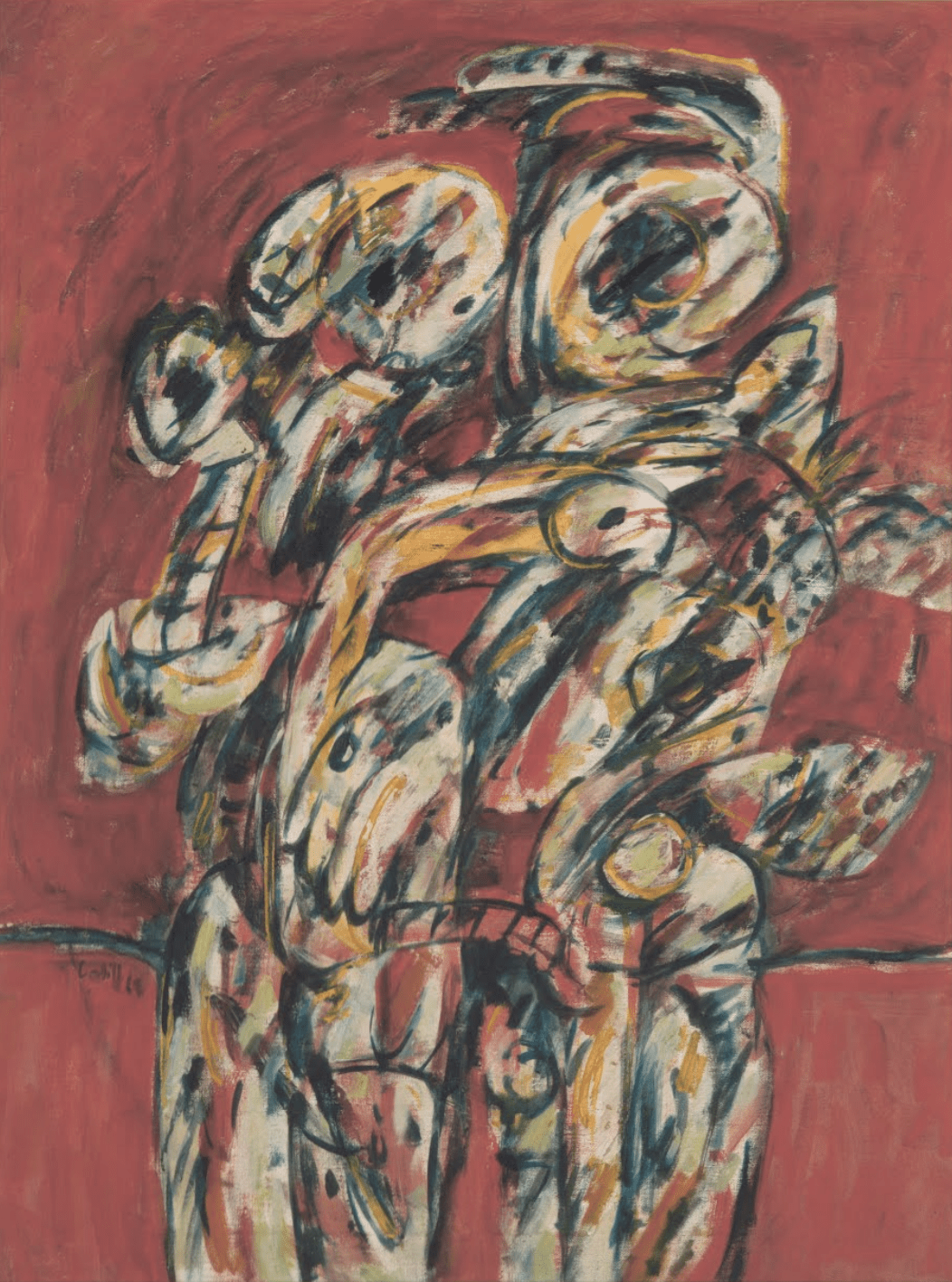
Two Standing Figures, Pago-Pago Series, Latiff Mohidin
Malaysian, b. 1941
1968 Oil on canvas National Gallery Singapore, Singapore
In this striking composition, two monumental, biomorphic forms dominate the canvas, pulsing with organic energy. Characterized by thick, aggressive black outlines and a vibrant palette of fiery hues, the intertwined figures resemble a dynamic hybrid of tropical flora, ancient temple architecture, and human anatomy. The work challenges the viewer to decipher the form, acting as a visual puzzle that blurs the boundary between the natural landscape and constructed, totemic monuments.
Insights
- The "Pago-Pago" Synthesis
The term “Pago-Pago” evolved from Pagoden (German for pagodas), a title Mohidin coined in 1961 after viewing ancient Asian artifacts in a Berlin ethnological museum. The ensuing series represents a profound visual synthesis of his exposure to German Expressionism while studying in West Berlin and his rediscovery of Southeast Asian aesthetics—specifically the interplay of architectural forms like temple eaves and natural elements like bamboo shoots.
- Technical Dynamism
Created a year before the culmination of the Pago-Pago era, this painting marks a distinct transition. Mohidin moves away from his earlier stacked, block-like totemic structures toward a fluid, asymmetrical dynamism. The composition is built on a composite of fiery colors and radiant forms, anchored by thick outlines, jagged edges, and highly controlled brushstrokes.
- Controversy and Duality
Often considered the most critical and controversial piece of the entire series, the painting depicts a pair of figures undergoing a radical, organic transformation. While it serves as a powerful metaphor celebrating nature’s exuberant vitality and the tension between civilization and the earth, the specific controversy surrounding the work largely stems from explicit sexual connotations analyzed by Malaysian art critic Redza Piyadasa.
- The "Wonder Boy" Poet
Mohidin demonstrated such a precocious understanding of painting during his youth in Singapore that he earned the nickname “Wonder Boy.” Beyond his canvases, he is a celebrated writer; his visual art and free-verse poetry are deeply intertwined, operating as parallel expressions of an avant-garde thinker looking to complicate Western modernism through deep regional dialogues.
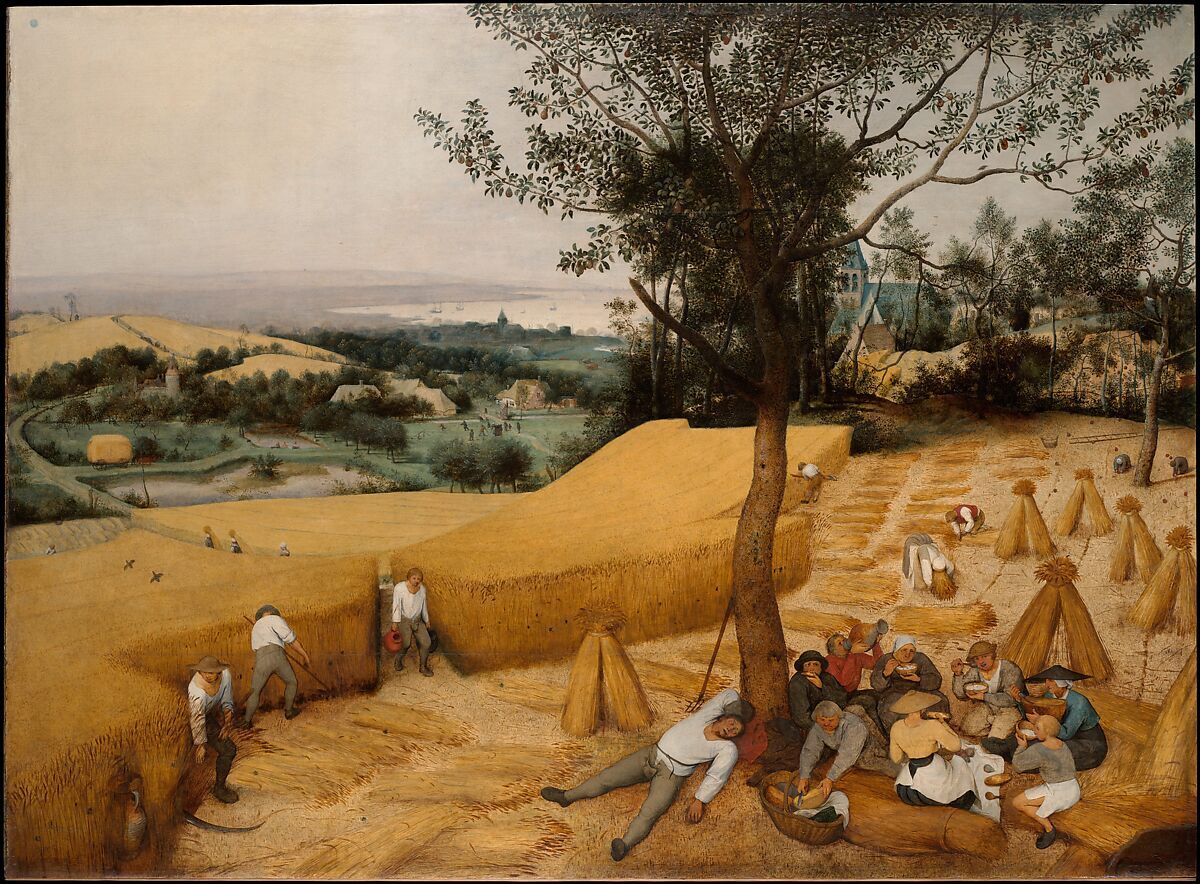
The Harvesters, Pieter Bruegel the Elder
Flemish, c. 1525–1569
1565 Oil on wood
This iconic work marks a pivotal shift in Western art: the elevation of the landscape and the common laborer to the primary subject of a painting. Originally commissioned as part of a six-part series depicting the months of the year (this panel represents late summer), Bruegel captures the grueling reality of peasant life with remarkable empathy and detail. In this cropped section, a worker cuts a path through a golden wall of wheat, leading the eye down toward the village and the hazy, atmospheric perspective of the distant valley. Bruegel balances the monumental scale of nature with the intimate, everyday actions of human survival.
Insights
- A Rare Series
The Harvesters is one of only five surviving paintings from Bruegel’s original series of the “Months.” They were commissioned by a wealthy Antwerp merchant to hang in his dining room.
- "Peasant Bruegel"
Bruegel earned the nickname “Peasant Bruegel” because he was famous for dressing up in peasant clothing and sneaking into country weddings and village fairs to sketch the laborers behaving naturally.
- Hidden Narratives
Bruegel’s landscapes are famous for being packed with tiny, hidden details. In the full version of this painting, viewers can find people playing games, monks bathing in a distant pond, and figures hidden deep within the wheat fields.
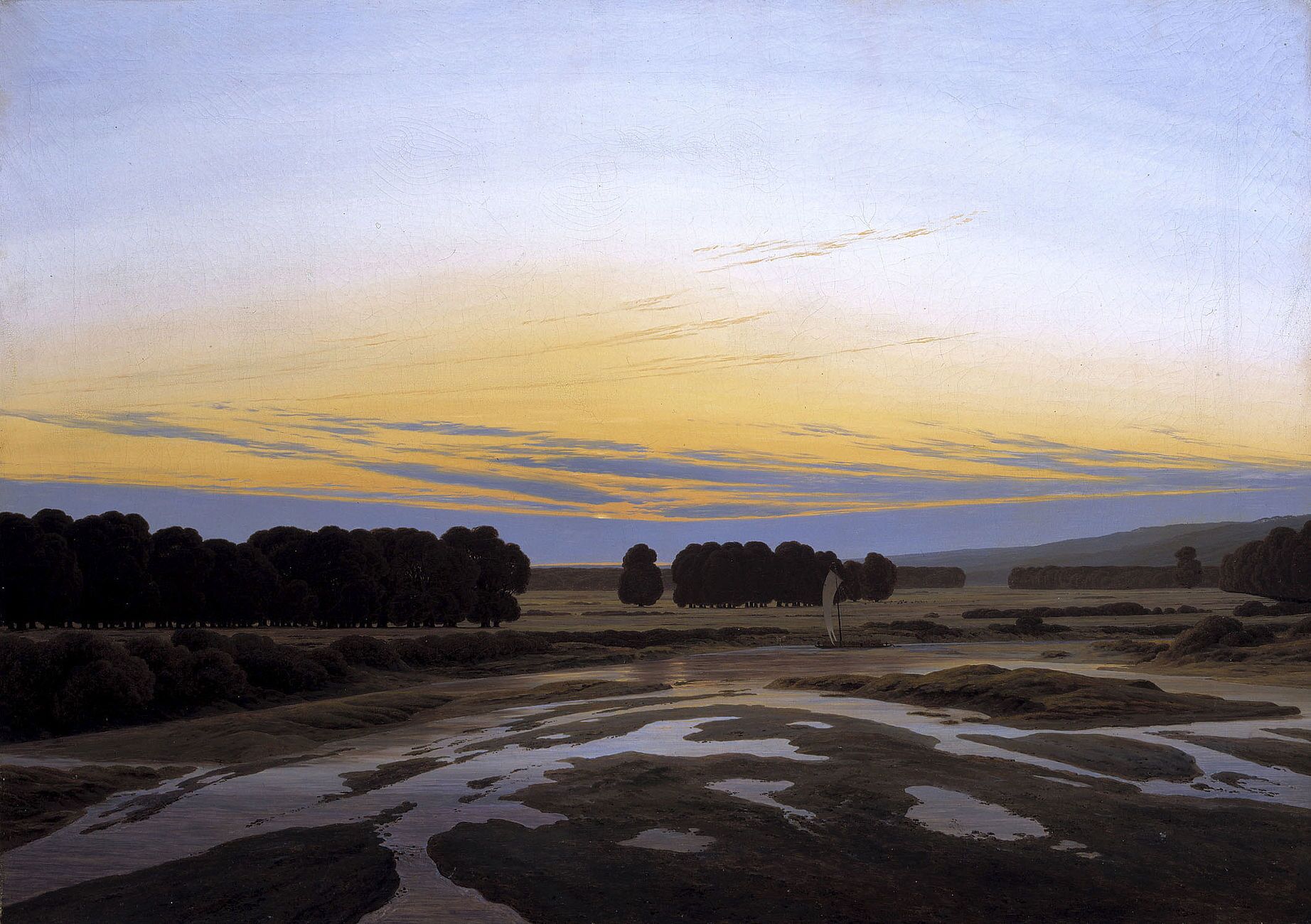
The Great Enclosure, Caspar David Friedrich
German, 1774-1840
c. 1831 Oil on canvas Albertinum, in the collection of the Galerie Neue Meister
The Great Enclosure is considered one of Caspar David Friedrich’s greatest late works and a key example of German Romantic landscape painting. Depicting the Elbe River floodplain near Dresden at sunset, the painting uses dramatic light and vast skies to evoke spiritual reflection and solitude. The small traces of human presence are overshadowed by nature’s grandeur, emphasizing Romantic ideas of the sublime. The glowing sunset and reflective water symbolize themes of transition, mortality, and transcendence, making the work a celebrated blend of realism and spirituality.
Insights
- German Romantic Master
Caspar David Friedrich is widely considered one of the most important painters of the German Romantic movement.
- Ostra Landscape
The painting’s German title, Das Große Gehege, refers to the Ostra enclosure area near Dresden along the Elbe River.
- Late Career Masterpiece
Art historian Werner Busch called The Great Enclosure the “crowning achievement” of Friedrich’s late career.
- Nature’s Vastness
Friedrich often painted tiny human figures against enormous landscapes to emphasize humanity’s smallness compared to nature and the divine.
- Spiritual Landscapes
Many of Friedrich’s paintings explore themes of spirituality, melancholy, mortality, and contemplation through natural scenery rather than traditional religious imagery.
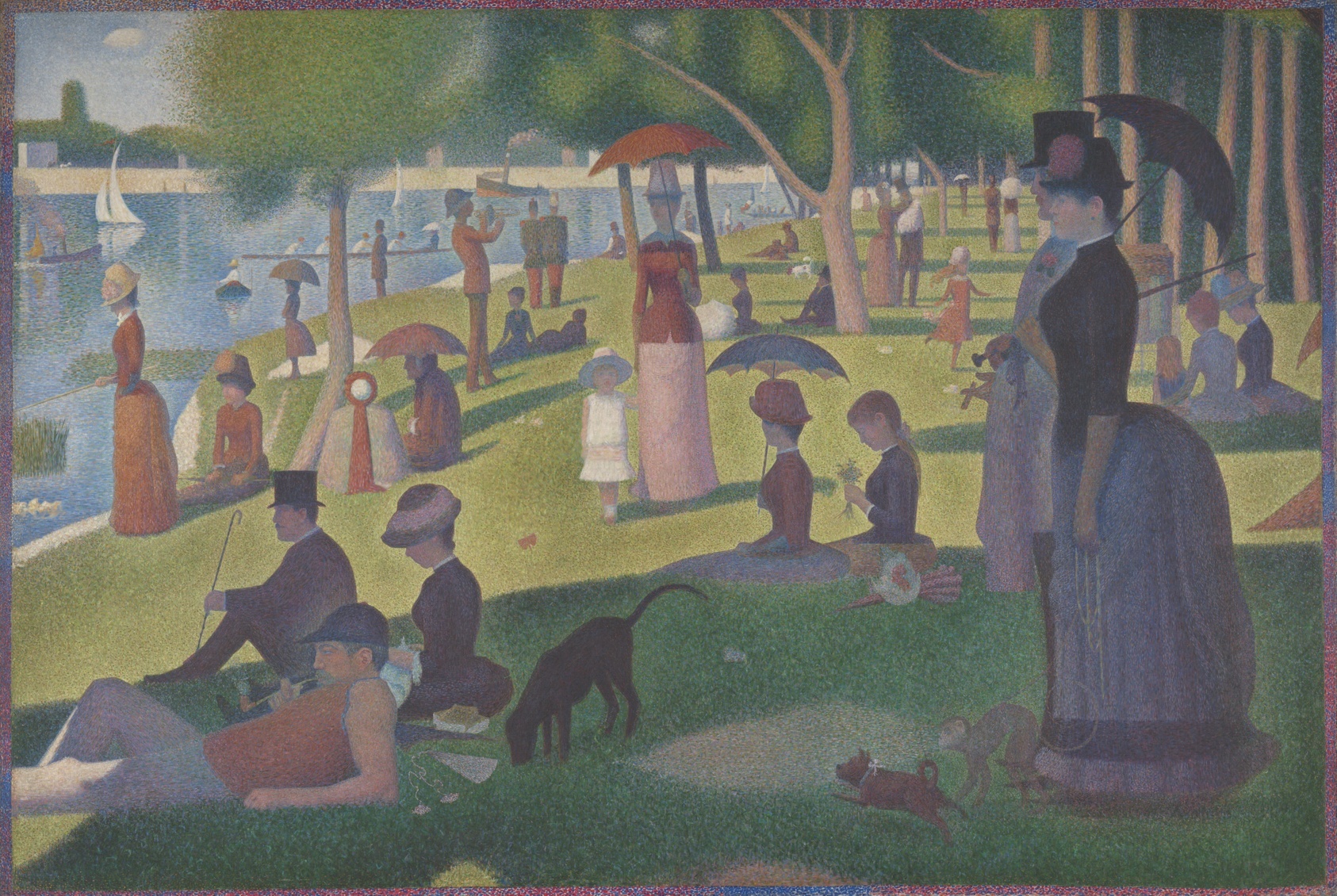
A Sunday on La Grande Jatte, Georges Seurat
French, 1859–1891
1884–1886 Oil on canvas The Art Institute of Chicago, Chicago
In this monumental work, Georges Seurat captures a typical Sunday afternoon on the island of La Grande Jatte, a popular suburban retreat along the Seine just outside of late 19th-century Paris.
Departing from the spontaneous, fleeting brushstrokes of his Impressionist contemporaries, Seurat painstakingly constructed this scene using a deeply mathematical and scientific approach to color and light.
The figures—representing a diverse cross-section of modern Parisian society—are frozen in strict, almost rigid profiles, elevating an everyday scene of middle-class leisure to the monumental gravity of a classical frieze.
Insights
- The Invention of Pointillism
Seurat pioneered a revolutionary technique he called “Chromoluminarism,” which was later dubbed Pointillism by a dismissive art critic. Instead of mixing paint on a palette, he applied tens of thousands of tiny dots of pure, unmixed, complementary colors directly onto the canvas. He relied entirely on the viewer’s retina to optically blend the colors from a distance to create maximum luminosity.
- A "Mural of Tin Soldiers"
When the massive painting debuted at the eighth (and final) Impressionist exhibition in 1886, it caused an absolute scandal. The stiff, motionless figures were highly controversial. Critics mocked the work, comparing the relaxed Parisians to “Egyptian wooden dolls” and “tin soldiers,” failing to recognize Seurat’s attempt to synthesize the grandeur of classical antiquity with modern life.
- Social Subtext and Subversion
While it appears to be a tranquil park scene, La Grande Jatte was known as a place where different social classes mingled, and illicit activities sometimes occurred. Seurat subtly embedded these realities: the mixing of top-hatted bourgeoisie with a sleeveless, pipe-smoking laborer in the foreground was a sharp nod to a changing, modernizing Paris.
- The Fading Sun
Much like other artists experimenting at the time, Seurat turned to newly invented, highly volatile chemical pigments to achieve his blinding highlights. He heavily used zinc yellow to capture the brilliant sunlight hitting the lawn. Tragically, this highly unstable pigment began to oxidize and darken to an ochre-brown almost immediately after the painting was completed, meaning modern viewers can never fully witness the vibrant greens and yellows Seurat originally intended.
- Obsessive Preparation
Seurat did not simply paint this scene on the spot. He spent over two years visiting the island daily, producing more than 60 highly detailed sketches and small oil studies (croquetons) of individual figures, lighting angles, and landscape features before meticulously transferring them onto the final, nearly 7-by-10-foot canvas in his studio.